It is quite common to hear complaints about the steep learning curve of R. And it is true that it would take time to grasp its versatility (if it is possible at all). Nevertheless, there are many packages that give the opportunity of experiencing the power of R for beginners. One notable example is Zelig package (Choirat et al. 2017). The online documentation provides examples for a wide range of models. As one can see in these examples, Zelig favors the use of simulation-based approach in estimating, interpreting, and presenting results of statistical analysis. King, Tomz, and Wittenberg (2000, 348) listed three advantages of this approach:
First, and most importantly, it can extract new quantities of interest from standard statistical models, thereby enriching the substance of social science research. Second, our approach allows scholars to assess the uncertainty surrounding any quantity of interest, so it should improve the candor and realism of statistical discourse about politics. Finally, our method can convert raw statistical results into results that everyone, regardless of statistical training, can comprehend.
Of course, easy-to-use does not necessarily mean easy to interpret and present: “researchers who put [these methods] into practice will have to think much harder about which quantities are of interest and how to communicate to a wider audience” (King, Tomz, and Wittenberg 2000, 360). Lets see an example using well-known Mroz’ data:
library(Zelig)
library(texreg) #for html table
df <- carData::Mroz
logit_zelig <- zelig(lfp ~ k5 + k618 + age + wc + hc + lwg,
                     data=df, model = "logit", cite=FALSE)
summary(logit_zelig, odds_ratio=TRUE)
## Model:
##
## Call:
## stats::glm(formula = lfp ~ k5 + k618 + age + wc + hc + lwg, family = binomial("logit"),
## data = as.data.frame(.))
##
## Deviance Residuals:
## Min 1Q Median 3Q Max
## -2.0875 -1.1168 0.6377 0.9797 2.1894
##
## Coefficients:
## Estimate (OR) Std. Error (OR) z value Pr(>|z|)
## (Intercept) 18.88881 11.87495 4.674 2.95e-06 ***
## k5 0.23725 0.04590 -7.436 1.03e-13 ***
## k618 0.91635 0.06119 -1.308 0.190810
## age 0.93358 0.01168 -5.492 3.98e-08 ***
## wcyes 1.99876 0.44711 3.096 0.001962 **
## hcyes 0.86741 0.16830 -0.733 0.463476
## lwg 1.75248 0.26083 3.769 0.000164 ***
## ---
## Signif. codes: 0 '***' 0.001 '**' 0.01 '*' 0.05 '.' 0.1 ' ' 1
##
## (Dispersion parameter for binomial family taken to be 1)
##
## Null deviance: 1029.75 on 752 degrees of freedom
## Residual deviance: 924.77 on 746 degrees of freedom
## AIC: 938.77
##
## Number of Fisher Scoring iterations: 4As we can see in the output, zelig function calls glm from stats. The following steps, however, illustrate how simulation approach is used to estimate expected and predicted values.
x_no_college <- setx(logit_zelig, wc = "no")
x_college <- setx1(logit_zelig, wc = "yes")
sim_logit_zelig <- sim(logit_zelig, x = x_no_college, x1 = x_college)
summary(sim_logit_zelig)
##
## sim x :
## -----
## ev
## mean sd 50% 2.5% 97.5%
## [1,] 0.5434036 0.02483741 0.5435714 0.4962461 0.5904441
## pv
## 0 1
## [1,] 0.46 0.54
##
## sim x1 :
## -----
## ev
## mean sd 50% 2.5% 97.5%
## [1,] 0.7008201 0.04802893 0.7038947 0.6022215 0.7840549
## pv
## 0 1
## [1,] 0.277 0.723
## fd
## mean sd 50% 2.5% 97.5%
## [1,] 0.1574164 0.04701865 0.1604971 0.06458937 0.2430327Now, we might want to estimate predicted probabilities over the range of a predictor for both levels of wc.
logit_zelig <- zelig(lfp ~ k5 + k618 + age + wc + hc + lwg,
                     data=df, model = "logit", cite=FALSE)

x_no_college  <- setx(logit_zelig, wc = "no",  age = 30:60)
x_college <- setx(logit_zelig, wc = "yes",  age = 30:60)
sim_logit_zelig <- sim(logit_zelig, x = x_no_college, x1 = x_college)
ci.plot(sim_logit_zelig, ylab = "Predicted Probability of Labor Force Participation")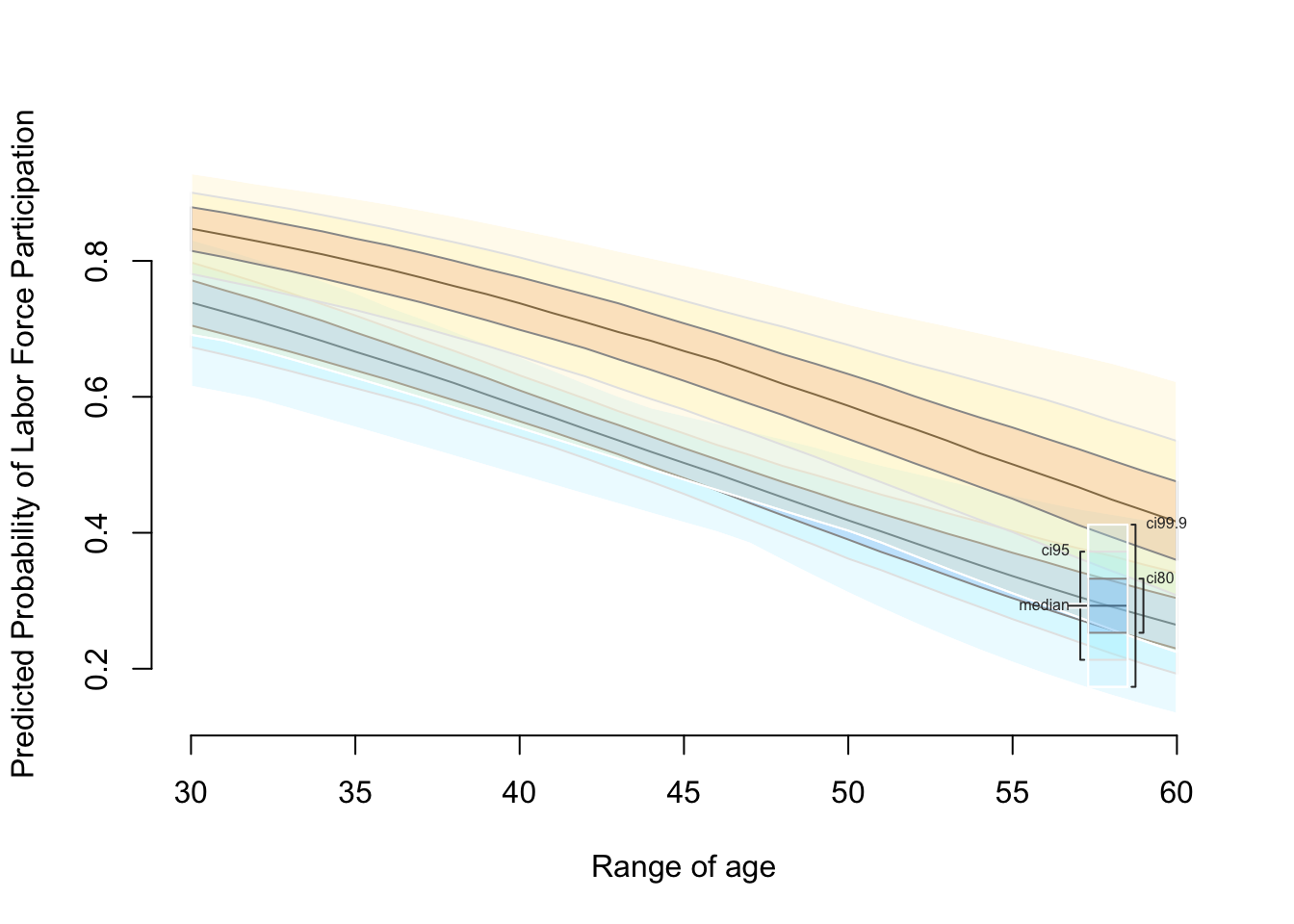
Another nice feature of Zelig package is the exterior interaction functions which help to extract information from Zelig object. For example, from_zelig_model() makes it easy to extract model results and pass them into a table function.
df_logit_model <- from_zelig_model(logit_zelig)
htmlreg(df_logit_model, center=FALSE, caption = " ")
Actually, texreg functions accept zelig class objects:
logit_zelig1 <- zelig(lfp ~ k5 + age,
                      data=df, model = "logit", cite=FALSE)
logit_zelig2 <- zelig(lfp ~ k5 + age + wc,
                      data=df, model = "logit", cite=FALSE)
logit_zelig3 <- zelig(lfp ~ k5 + age + wc + lwg,
                      data=df, model = "logit", cite=FALSE)
logit_zelig4 <- zelig(lfp ~ k5 + age + wc + lwg + inc,
                      data=df, model = "logit", cite=FALSE)
htmlreg(list(logit_zelig1, logit_zelig2, logit_zelig3, logit_zelig4),
center=FALSE, caption = " ")| Model 1 | Model 2 | Model 3 | Model 4 | ||
|---|---|---|---|---|---|
| (Intercept) | 3.09*** | 2.92*** | 2.44*** | 2.90*** | |
| (0.50) | (0.50) | (0.52) | (0.54) | ||
| k5 | -1.32*** | -1.41*** | -1.41*** | -1.43*** | |
| (0.19) | (0.19) | (0.19) | (0.19) | ||
| age | -0.06*** | -0.06*** | -0.06*** | -0.06*** | |
| (0.01) | (0.01) | (0.01) | (0.01) | ||
| wcyes | 0.83*** | 0.62** | 0.87*** | ||
| (0.18) | (0.19) | (0.21) | |||
| lwg | 0.57*** | 0.62*** | |||
| (0.15) | (0.15) | ||||
| inc | -0.03*** | ||||
| (0.01) | |||||
| AIC | 970.48 | 950.86 | 937.09 | 918.46 | |
| BIC | 984.36 | 969.36 | 960.21 | 946.20 | |
| Log Likelihood | -482.24 | -471.43 | -463.54 | -453.23 | |
| Deviance | 964.48 | 942.86 | 927.09 | 906.46 | |
| Num. obs. | 753 | 753 | 753 | 753 | |
| p < 0.001, p < 0.01, p < 0.05 | |||||
References
Choirat, Christine, James Honaker, Kosuke Imai, Gary King, and Olivia Lau. 2017. Zelig: Everyone’s Statistical Software. http://zeligproject.org/.
Imai, Kosuke, Gary King, and Olivia Lau. 2008. “Toward a Common Framework for Statistical Analysis and Development.” Journal of Computational Graphics and Statistics 17 (4): 892–913. http://j.mp/msE15c.
King, Gary, Michael Tomz, and Jason Wittenberg. 2000. “Making the most of statistical analyses: Improving interpretation and presentation.” American Journal of Political Science 44 (13-2): 341–55.
Leifeld, Philip. 2013. “texreg: Conversion of Statistical Model Output in R to LaTeX and HTML Tables.” Journal of Statistical Software 55 (8): 1–24. http://www.jstatsoft.org/v55/i08/.